Top Free AI Essay Writers & Detectors: Capabilities vs Hallucinations
Evaluate free AI essay writers and detection tools across perplexity scoring, burstiness variance, citation hallucination benchmarks, and false positive rates.
The rapid proliferation of large language models has fundamentally transformed academic writing and research drafting. When students, technical communicators, and researchers look for an ai essay writer free utility or explore free ai essay generator options, they enter an ecosystem characterized by remarkable linguistic fluency on one side, and insidious factual unreliability on the other. While modern language models can draft complex syntactic arguments in seconds, their inability to ground claims in empirical truth produces phantom citations, fabricated historical data, and confident falsehoods. Simultaneously, statistical tools built to act as an ai detector for essays struggle with high false-positive rates and structural biases. This engineering guide investigates the dual mechanics of AI writing generators and statistical detection engines, examining token probability distributions, perplexity curves, hallucination benchmarks, and ethical verification frameworks.
Generative Writing vs Detection Architecture
The technological arms race between generative language models and statistical AI detectors operates on opposing sides of mathematical entropy:
1. Generation Engine
Autoregressive LLM
Softmax token selection
2. Failure Mode
Stochastic Hallucination
Phantom citations & DOIs
3. Detection Metric
Perplexity & Burstiness
Syntactic entropy analysis
4. Verification Model
Human-in-the-Loop
Deterministic source audit
How Generative NLP Models Generate Essays: Autoregressive Next-Token Probability
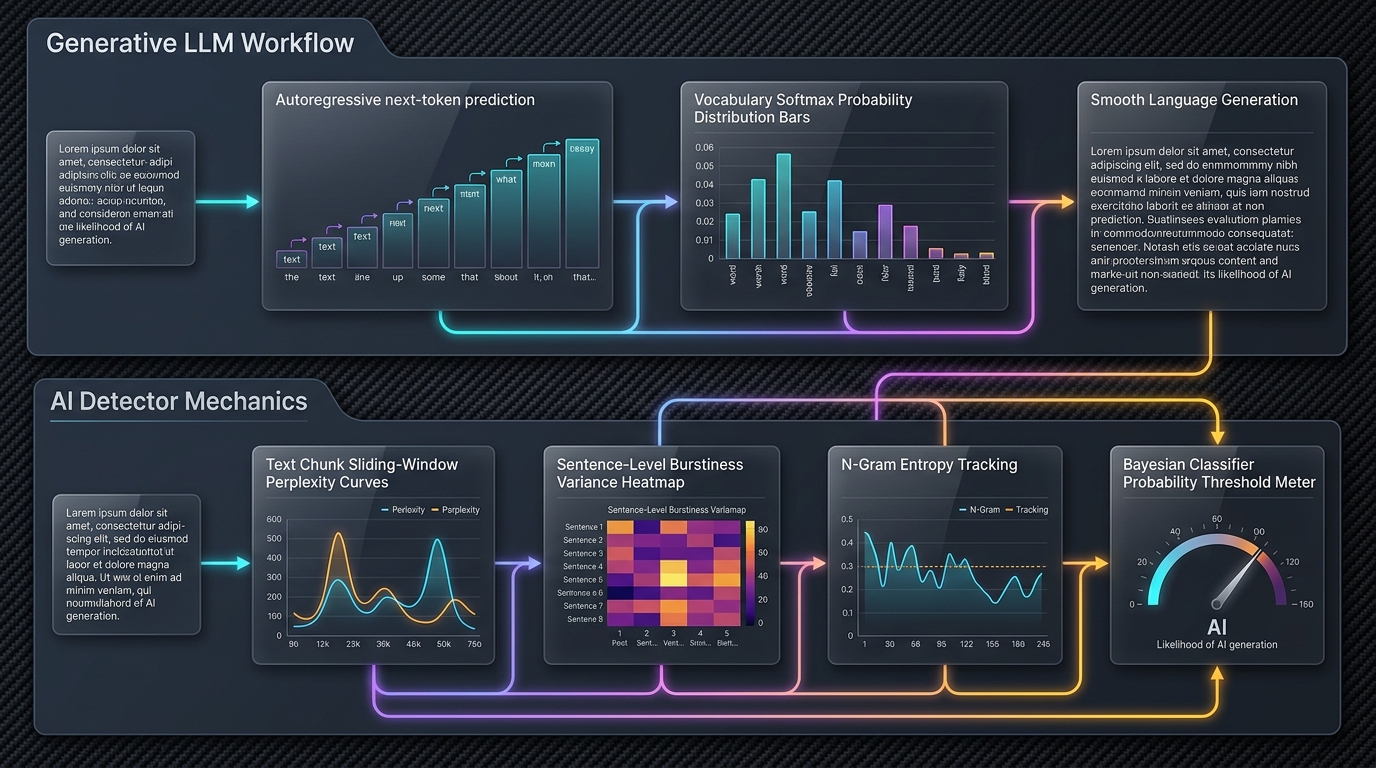
To understand both the power and limitations of generative writing platforms, researchers must demystify what happens under the hood of modern transformer architectures. Large language models (such as GPT-4o, Claude 3.5 Sonnet, Gemini 1.5 Pro, and open-weights models like Llama 3) do not possess consciousness, factual intent, or a knowledge graph of objective reality. Instead, they are massive autoregressive neural networks trained to predict the conditional probability distribution of the next token given a sequence of preceding context tokens.
When a user prompts a model to write an essay on macroeconomic fiscal policy, the model decomposes the prompt into sub-word tokens. Across hundreds of transformer layers, multi-head self-attention mechanisms calculate semantic relationships between tokens across long context windows. The final layer computes a raw logit score for every token in the model vocabulary (typically 50,000 to 128,000 discrete tokens), which is normalized into a probability distribution via the Softmax activation function:
# Mathematical representation of conditional next-token probability:
# P(w_t | w_1, w_2, ..., w_{t-1}) = Softmax(W_vocab * h_t)

# During inference, sampling algorithms govern token selection:
# 1. Greedy Decoding: Selects argmax (highest probability token) -> highly repetitive
# 2. Temperature (T): Scales logits before Softmax (T < 1.0 reduces randomness, T > 1.0 increases diversity)
# 3. Top-p (Nucleus) Sampling: Restricts sampling pool to the smallest set of tokens whose cumulative probability exceeds p (e.g., p = 0.90)
Because the model samples from high-probability distributions, the resulting prose sounds exceptionally fluent, formal, and authoritative. However, probability is not truth. The model selects words because they are statistically plausible companions in a given grammatical structure, not because the underlying statement has been verified against historical archives or scientific consensus.
Top Free AI Essay Writers Evaluated: Capabilities and Feature Constraints
For users exploring the best free ai essay writer platforms, understanding the difference between standalone commercial frontends and foundational language models is crucial. Many promotional websites advertising an ai essay writer free without sign up are thin wrapper applications routing prompts through third-party APIs with restrictive rate limits. The table below evaluates the primary free tools accessible for essay drafting and structural outlining:
Tool / Platform
Underlying Model
Free Tier Quota
Primary Strength
Architectural Limitation
ChatGPT (Free)
GPT-4o mini / GPT-4o
Dynamic hourly message caps
Strong structural logic, rapid outlining
Prone to formulaic 5-paragraph essay structures
Google Gemini (Free)
Gemini 1.5 Flash
Generous daily query limits
Native Google Search grounding, large context
Inconsistent academic citation formatting
Claude (Free)
Claude 3.5 Sonnet
Strict periodic session limits
Nuanced prose, high voice adaptability
Strict usage throttles during peak compute hours
Perplexity AI (Free)
Custom RAG Pipeline
Unlimited standard searches
Real-time live citations with web links
Summarizes snippets rather than drafting full essays
QuillBot Co-Writer
Fine-tuned Seq2Seq
Limited daily generation words
Sentence paraphrasing and grammar checks
Lacks long-form cohesive argument synthesis
When evaluating tools marketed specifically as standalone essay generators, users should proceed with caution. Many utilities claim to offer "100% undetectable essays" by running outputs through crude synonym replacement algorithms or character obfuscation scripts. These techniques degrade prose quality, introduce bizarre vocabulary choices, and frequently trigger secondary detection flags.
Architectural pipeline comparing generative autoregressive language models against statistical perplexity and burstiness detection algorithms.
The Hallucination Epidemic: Phantom Citations, Fabricated DOIs & Fake Quotes
The single most perilous vulnerability in academic AI generation is the phenomenon of stochastic hallucination. In natural language processing, a hallucination occurs when an LLM generates text that is syntactically coherent, grammatically impeccable, and completely untruthful.
In academic contexts, hallucinations manifest primarily in three dangerous patterns:
1. Phantom Bibliographies
When asked for peer-reviewed citations, models combine real researchers with plausible journal titles and fabricated publication years (e.g., pairing a real Harvard economics professor with a paper they never wrote).
Risk: Immediate academic integrity violation.
2. Fabricated Digital Object Identifiers
Models generate structurally valid DOI strings (e.g., 10.1016/j.cell.2023.04.012). When entered into Crossref or doi.org, these resolve to completely unrelated biology papers or return HTTP 404 errors.
Risk: Instant disqualification in peer review.
3. Historical & Statistical Inventions
When arguing a thesis, models fabricate quantitative metrics (e.g., "a 2021 study revealed a 43.8% increase") and attribute fabricated quotes to historical figures without factual basis.
Risk: Spreading verifiable misinformation.
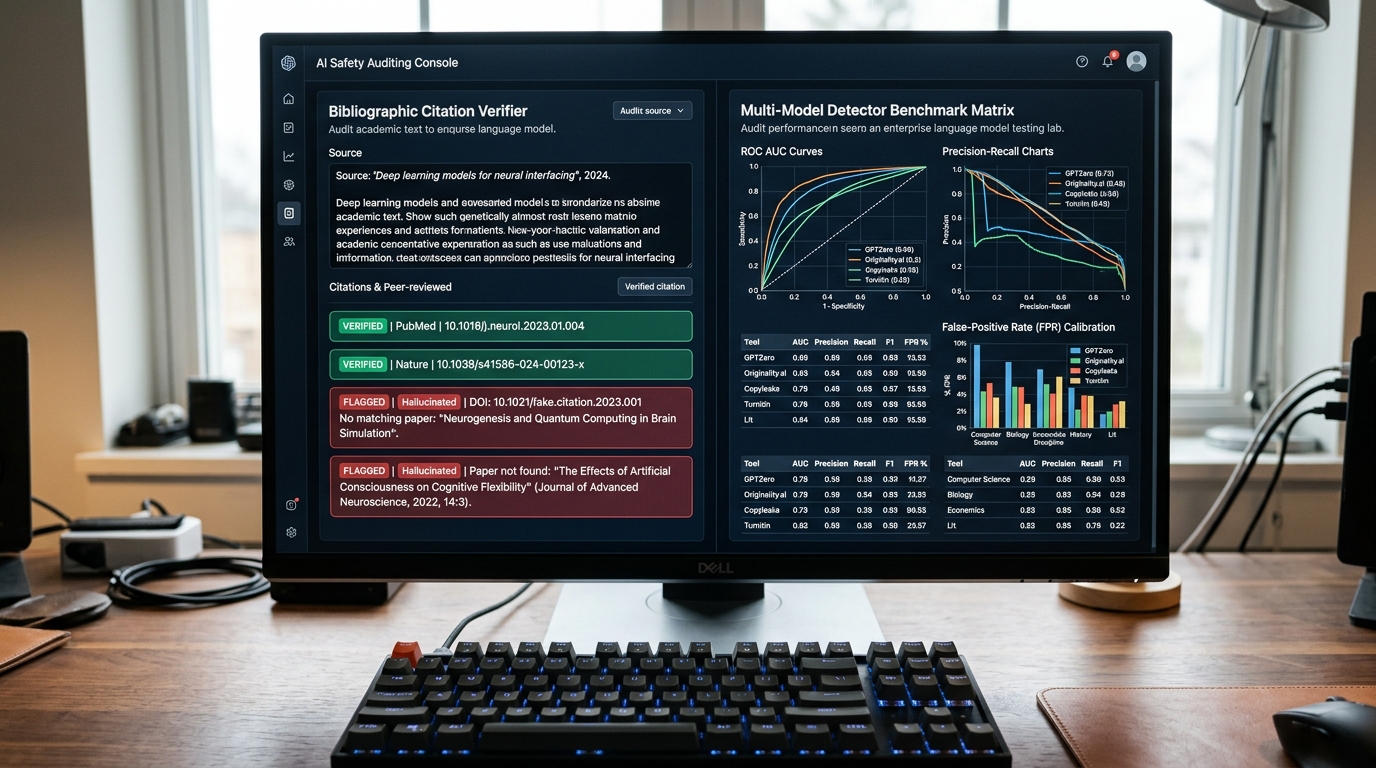
Why does this occur? Because large language models lack an internal epistemic verification loop. When human researchers write, they consult primary sources and verify claims against recorded evidence. When an LLM generates text, its objective function is strictly maximum-likelihood next-token prediction. If the prompt demands an APA citation, the model constructs tokens that resemble APA citations. In benchmark evaluations of ungrounded LLM outputs, citation hallucination rates routinely exceed 30% to 50% in specialized scientific domains.
The Mathematics of AI Detection: Perplexity, Burstiness & N-Gram Entropy
To combat unauthorized AI generation in academic and publishing workflows, specialized software platforms claim to detect AI-authored text. Rather than looking for "watermarks" in raw text, statistical detectors (such as GPTZero and early detection classifiers) analyze structural language characteristics through two core mathematical metrics: perplexity and burstiness.
Mathematical Foundation: Perplexity (PPL)
Perplexity measures the uncertainty or "surprise" of a language model when predicting a sample of text. Formally, it is the exponentiated cross-entropy loss of the sequence:
# Perplexity calculation over sequence W of N tokens:
# PPL(W) = exp( - (1/N) * sum_{i=1}^N log P(w_i | w_1, ..., w_{i-1}) )
Because AI models prioritize high-probability tokens during generation, machine-generated text exhibits consistently low perplexity across the entire text block. Human writing, by contrast, frequently incorporates unexpected vocabulary, idioms, metaphors, and idiosyncratic phrasing, yielding substantially higher and more volatile perplexity scores.
Mathematical Foundation: Burstiness
While perplexity evaluates token-level probability, burstiness evaluates the variation in sentence length, syntactic structure, and semantic density across paragraphs:
# Burstiness variance calculation:
# Burstiness = (sigma_length - mu_length) / (sigma_length + mu_length)
# Where mu is the mean sentence length and sigma is the standard deviation.
Human authors write with dynamic, uneven cadence. A long, multi-clause compound sentence detailing an intricate historical cause is often followed by a brief, punchy concluding observation. Generative models, conversely, maintain uniform sentence lengths (typically 18 to 24 words) and repetitive grammatical patterns, creating a flat burstiness profile that statistical detectors flag as machine-generated.
Leading AI Detectors Benchmarked: Accuracy, ROC Curves & Detection Evasion
When institutions deploy an ai detector for essays, administrators often assume these tools operate with deterministic, forensic precision. In reality, empirical testing reveals wide variations in True Positive Rates (TPR), False Positive Rates (FPR), and sensitivity to paraphrasing attacks.
Detection Platform
Detection Methodology
True Positive (Clean AI)
False Positive Rate (Human)
Paraphrase Evasion Vulnerability
GPTZero
Perplexity + Burstiness + Fine-tuned RoBERTa
88% - 94%
1.5% - 3.2%
Moderate (prompt engineering reduces accuracy)
Turnitin AI Detector
Transformer-based Classifier (Trained on Academic Data)
85% - 91%
1.0% - 2.5%
Low to Moderate (flags heavy structural edits)
CopyLeaks
Multi-Language Deep Learning Embeddings
90% - 96%
3.0% - 5.5%
Low (aggressive classifier catches synonym swaps)
Originality.ai
Aggressive Commercial Classifier (Web/SEO focus)
92% - 97%
4.0% - 8.0%
Very Low (calibrated for high sensitivity)
Sapling AI
Token-level Probability Mapping
75% - 82%
< 1.5%
High (easily bypassed by humanization tools)
A critical finding across peer-reviewed evaluations is that all statistical detectors degrade significantly when presented with hybrid text (human-written essays edited by AI, or AI drafts revised by human writers). When human and machine tokens intermingle, perplexity profiles blur, causing detector confidence intervals to collapse toward 50% random guessing.
The False-Positive Crisis: Biases Against Non-Native English Writers
The most alarming ethical consequence of relying on automated AI text detectors in educational institutions is the systematic bias against non-native English speakers (English as a Second Language / ESL writers). Landmark research conducted at Stanford University demonstrated that commercial AI detectors misclassified genuine human-written essays by non-native English speakers as AI-generated over 61% of the time.
Why AI Detectors Falsely Accuse Non-Native Writers
Non-native writers are trained to use standardized grammatical templates, formal transitions (such as "in addition", "furthermore", "on the other hand"), and straightforward vocabulary to minimize lexical errors. By eliminating colloquialisms, slang, and idiosyncratic sentence fragments, ESL writing naturally scores very low in perplexity and exhibits low burstiness. To a statistical detector, clean, standardized, academic English is mathematically indistinguishable from GPT-4o output. Accusing students of academic misconduct based solely on detector scores represents an unscientific and discriminatory practice.
Because post-hoc statistical detection is fundamentally probabilistic and vulnerable to false positives, AI research labs are pivoting toward cryptographic provenance and generation-time watermarking. The most prominent example is SynthID, developed by Google DeepMind and deployed across Gemini models.
Unlike naive watermarking that inserts secret hidden characters or acrostic patterns, SynthID operates directly within the model token sampling stage:
# SynthID Mathematical Watermarking Pipeline:
# 1. During generation, a pseudorandom tournament function uses a secret cryptographic key
# 2. It introduces subtle statistical biases into the Softmax probability distribution
# 3. Tokens belonging to the "watermarked bucket" receive slightly elevated probabilities
# 4. Result: The text remains completely natural and semantic quality is unaltered
# 5. Detection: A verification detector evaluates the cumulative token distribution across a text sample
# 6. Resilience: Survives light paraphrasing, synonym replacement, and partial truncation
Complementing text watermarking, open standards like C2PA (Coalition for Content Provenance and Authenticity) embed signed cryptographic metadata into document headers. While C2PA is predominantly applied to digital media, enterprise document workflows increasingly track authoring provenance from initial draft to final publication.
Given the severe hallucination risks of automated generation and the unreliability of detectors, how should professionals, students, and engineers utilize language models in writing workflows? The solution lies in structured Human-in-the-Loop (HITL) methodology, where AI serves as an interactive research assistant rather than an autonomous author:
Stage 1: Thesis Exploration & Counter-Argument Generation: Use the model to challenge your working thesis. Prompt: "Review this argument regarding cloud database migration. Provide the top three technical counter-arguments an enterprise systems architect would raise."
Stage 2: Structural Outlining & Section Scaffolding: Task the model with organizing complex thoughts into logical hierarchies. You retain ownership of the thesis while using the model to ensure all prerequisite concepts are addressed in sequence.
Stage 3: Manual Primary Research & Bibliographic Verification: Never permit the AI to write your literature review or bibliography. Manually search peer-reviewed repositories (such as IEEE Xplore, ACM Digital Library, PubMed, or Google Scholar) to extract verified citations, DOIs, and empirical data.
Stage 4: Autonomous Human Drafting: Write the core body paragraphs yourself. Inject your domain expertise, practical engineering observations, and nuanced human voice. This naturally ensures high perplexity and dynamic burstiness that reflects authentic cognitive engagement.
Stage 5: AI-Assisted Line Editing & Clarity Polishing: Once your draft is complete, use language models to audit sentence clarity, eliminate passive voice, and identify grammatical inconsistencies. Treat the model as a strict copy editor rather than a content generator.
Free AI Essay Writers & Detectors Comprehensive Feature Matrix
The matrix below contrasts the operational parameters, detection methodologies, and safety mechanisms across leading free AI writing and detection platforms:
Initial screening flag; never standalone disciplinary proof
Cryptographic Watermarks (SynthID)
Model Provenance
Biased Softmax Pseudorandom Sampling
Zero False Positives (Mathematically Bound)
Authoritative model attribution and audit compliance
Practical Auditing Checklist: How to Detect AI Hallucinations in Drafts
When reviewing academic papers, student essays, or technical documentation suspected of containing unverified AI generation, use the systematic verification checklist below to expose hallucinations before publication:
1. Perform Literal DOI Resolution
Copy every DOI string listed in the bibliography and paste it directly into doi.org. If the link returns an error or directs to an article with a different title, author list, or subject matter, the reference is a confirmed hallucination.
2. Cross-Reference Author Bibliographies on Google Scholar
Search the cited author's verified Google Scholar or ORCID profile. If the author is a recognized academic in the field but the specific cited paper does not exist on their publication list, the model synthesized an author-concept pair without historical backing.
3. Examine Direct Quotations with Exact String Matching
Enclose cited quotations within quotation marks and search Google Books or JSTOR. Large language models frequently fabricate plausible quotes that capture the general ethos of a philosopher or scientist but were never actually uttered or written by the subject.
Watch for characteristic AI stylistic hallmarks: three-part lists, repetitive use of phrases like "delving into", "crucial role", "testament to", or paragraphs structured uniformly as: claim, elaboration, qualification, and balanced conclusion. Human writing typically exhibits sharper argumentative stances and irregular structural flow.
Authoritative AI Safety and NLP Research Documentation
For deeper research into token entropy, detection limitations, and ethical generative AI frameworks, consult official research publications:
No. Generative language models operate autoregressively by predicting statistically probable token sequences based on public training data. They cannot perform novel empirical research, execute laboratory experiments, or verify external physical facts. Using an ai essay writer free tool for primary research results in derivative synthesis and severe citation fabrication.
Evan Mitchell• Cloud Infrastructure Specialist & Systems Administrator3+ Years Industry Experience
Systems administrator with 3+ years managing enterprise Linux servers, AWS EC2 instances, and Docker containers. Evan focuses on practical bash scripting and secure network configurations.