What is Agentic AI? Autonomous Multi-Agent Frameworks Explained
Understand what is agentic AI and how autonomous multi-agent frameworks operate. Inspect planning loops, tool calling, state machines, and enterprise trust guardrails.
Agentic AI represents a fundamental shift from passive, prompt-and-response text generation toward autonomous software systems capable of independent reasoning, multi-step planning, and direct environment interaction. While traditional foundational models function as stateless inference engines, an agentic system operates in a continuous control loop: perceiving external state, selecting actions, invoking software tools via structured APIs, and evaluating execution results to correct mistakes. For software engineers and operations teams, understanding what is agentic AI and how autonomous multi-agent frameworks operate is essential for building production-ready automation without risking unchecked execution failures or data corruption.
Quick Architecture Summary
Autonomous agents combine four core components: a reasoning core (LLM), planning algorithms (task decomposition and reflection), memory systems (short-term working state and long-term vector stores), and external tool interfaces (API function calling, database query drivers, and code execution sandboxes).
Defining Agentic AI: Beyond Traditional Generative Models
To establish a formal agentic ai definition, researchers describe systems where models take goal-directed initiative. When newcomers ask what does agentic ai mean or seek to define agentic in simple language, it refers to artificial intelligence that acts with intentionality. If someone asks what is agentic artificial intelligence, it describes models that plan, execute, and verify tasks autonomously rather than merely writing text. Questions like is agentic a word or what does agentic mean frequently arise; linguistically, an agentic def traces back to agency in cognitive psychology, representing the power to originate actions. In industry discussions, whether searching for an agentic mean or understanding agenic meaning, practitioners emphasize proactive agentic behavior over reactive responses. Even informal shorthand terms like agen ai point toward this exact paradigm.
When IT leaders inquire why agentic ai is gaining rapid momentum, the answer lies in its ability to solve multi-turn challenges. If you ask what is agentic ai in simple terms, it is an AI that uses computers the way human technicians do: reading outputs, running scripts, and fixing errors. In enterprise discussions regarding what is agentic ai and how will it change work, analysts predict that static workflows will transform into dynamic teams of agents handling routine operations. This agentic advancement definition highlights systems equipped with high-level agentic capabilities, performing complex agentic ai automation across databases, networks, and cloud infrastructure.
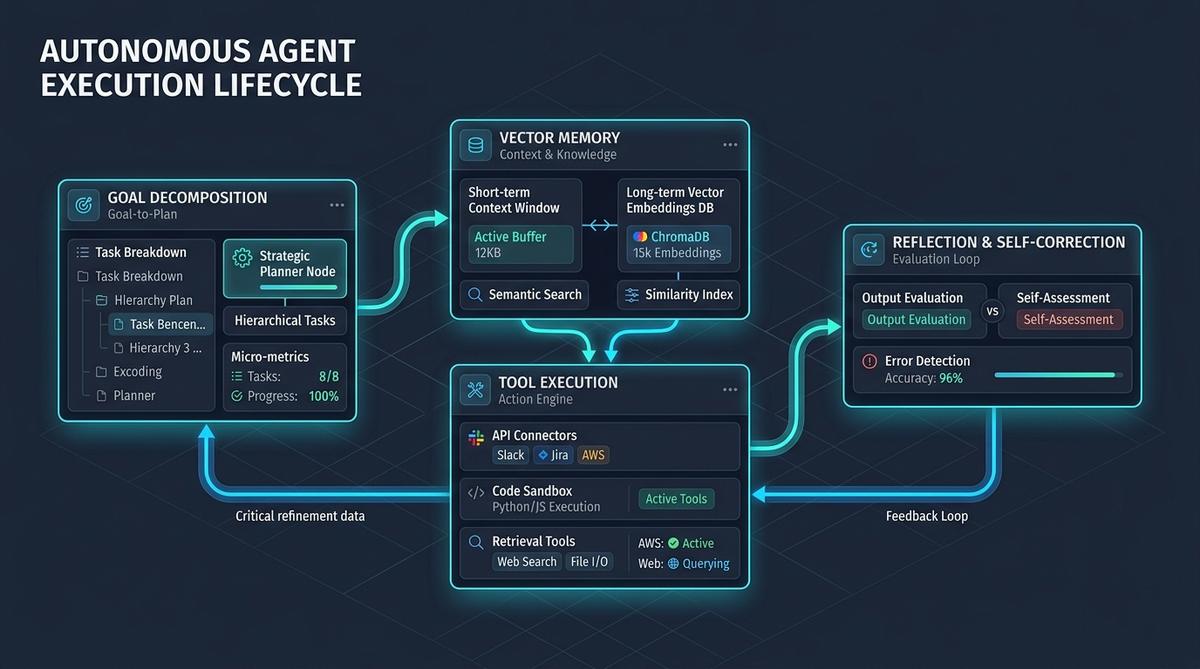
The standard operational loop of an agentic system explains how does agentic ai work. Following the ReAct (Reasoning and Acting) framework, the model alternates between internal thought traces and external actions:
Perception: The agent receives an input objective along with observations from previous tool outputs, system logs, or environment signals.
Reasoning: The model evaluates its current progress against the primary goal, identifying what information is missing or what action must occur next.
Action: The agent outputs a structured tool invocation, such as a database query, an HTTP GET request, or a shell execution command.
Feedback and Reflection: The environment executes the tool and returns the response to the agent. If the tool raises an exception, the agent inspects the error trace and formulates an alternative approach.
This closed-loop feedback mechanism enables autonomous agents to solve complex operational tasks, such as diagnosing production server incidents, generating and executing database migration scripts, or reconciling enterprise software catalogs.
Core Anatomy of an Autonomous Agent Architecture
A production-ready agent requires more than just an API key to a reasoning model. Production implementations structure the agent around four foundational subsystems:
1. Planning Engine: Autonomous agents use task decomposition to convert broad user instructions into executable dependency graphs. Advanced systems deploy Tree-of-Thought (ToT) or Least-to-Most prompting to generate alternative execution branches, pruning invalid plans before executing API calls.
2. Tool Calling Interface: Agents connect to external environments through structured JSON schemas. When an agent decides to inspect a server, it formats arguments according to a defined function signature, which the hosting runtime executes in an isolated environment.
3. Working and Long-Term Memory: Short-term memory retains the active context window, scratchpad notes, and recent tool responses. Long-term memory connects to vector embeddings and document stores, retrieving historical problem resolutions across previous sessions.
4. Self-Correction and Evaluation: Rather than returning unverified results, the agent runs validation scripts against its own output. For coding tasks, an agent executes unit tests inside a Docker container; if tests fail, it edits the source code until all assertions pass.
To evaluate how distributed systems isolate compute processes and runtime workloads, examine our breakdown on Docker container architecture, which provides the sandboxed execution boundaries required for safe agent code execution.
Multi-agent topologies divide monolithic reasoning into specialized worker nodes with stateful handoffs.
Multi-Agent Orchestration Patterns and Topologies
While single-agent systems handle straightforward automation, they degrade when tasks require specialized domain knowledge or exceed context token boundaries. A single agent attempting to write code, verify security compliance, optimize database performance, and draft documentation often suffers from role confusion and hallucination. Multi-agent systems resolve this limitation by dividing responsibilities across focused worker nodes.
When selecting software foundations, developers evaluate what is ai agent framework and what is agentic framework tooling. At its core, an open source agentic ai framework provides state graphs, message queues, and execution runtimes for multi-agent collaboration. Utilizing open source agentic ai libraries allows platform architects to retain full control over private weights, local tool endpoints, and sensitive corporate data.
Engineers design multi-agent networks using three primary architectural patterns:
Sequential Handoffs: Agents operate in a linear assembly line. An intake agent parses raw input, hands structured requirements to an execution agent, which passes output to a verification agent for final approval.
Hierarchical Supervisor Pattern: A central coordinator agent acts as a project lead. It analyzes the overarching goal, routes specific subtasks to specialized subordinate agents (such as a SQL Specialist, an API Technician, and a QA Auditor), and synthesizes their outputs into a unified response.
Consensus and Collaboration (Blackboard Pattern): Multiple agents share a persistent state blackboard. Agents asynchronously inspect the blackboard, contribute domain-specific observations, and debate proposed solutions until reaching mathematical or semantic consensus.
Framework Comparison Matrix: LangGraph, CrewAI, and AutoGen
Selecting an autonomous agent framework depends on architectural requirements regarding state persistence, determinism, and developer tooling. The matrix below contrasts the leading multi-agent frameworks deployed in production environments:
Evaluation Criteria
LangGraph
CrewAI
Microsoft AutoGen
Core Architecture
Cyclic State Machine Graphs
Role-Based Agent Teams
Conversational Event-Driven
State Management
Centralized Typed State
Task-Level Memory Passing
Chat Context Exchange
Deterministic Control
High (Explicit Edge Routing)
Medium (Process Flows)
Variable (Emergent Dialogue)
Human-in-the-Loop
Native State Interrupts
Task Approval Flags
User Proxy Integration
Production Readiness
Enterprise Production Standard
Rapid Prototyping & Pilots
Research & Simulation Fleets
Building a Multi-Agent Supervisor in Python
Implementing a resilient multi-agent workflow requires defining explicit schemas for state handoffs, routing logic, and tool execution boundaries. The following Python implementation demonstrates a production-style supervisor pattern using structured typing and conditional execution routing:
from typing import Annotated, Dict, List, Literal, TypedDict
import operator

# Define central multi-agent state schema
class AgentSystemState(TypedDict):
    task_description: str
    messages: Annotated[List[Dict[str, str]], operator.add]
    assigned_worker: str
    current_status: Literal["in_progress", "awaiting_approval", "completed", "failed"]
    execution_artifacts: Dict[str, str]
    iteration_counter: int

# Routing Supervisor Node
def supervisor_router(state: AgentSystemState) -> Dict:
    counter = state.get("iteration_counter", 0)

    # Enforce recursion limit to prevent infinite loops
    if counter >= 5:
        return {
            "assigned_worker": "human_reviewer",
            "current_status": "awaiting_approval",
            "iteration_counter": counter + 1
        }

    task = state["task_description"].lower()

    # Route based on domain requirements
    if "sql" in task or "database" in task:
        next_worker = "database_engineer"
    elif "test" in task or "verify" in task:
        next_worker = "qa_evaluator"
    else:
        next_worker = "code_developer"

    return {
        "assigned_worker": next_worker,
        "current_status": "in_progress",
        "iteration_counter": counter + 1
    }

# Specialized Worker Execution Node
def database_worker_node(state: AgentSystemState) -> Dict:
    log_entry = {"role": "assistant", "name": "db_worker", "content": "Executed read-only index query."}
    artifacts = state.get("execution_artifacts", {})
    artifacts["query_result"] = "Rows inspected: 1,420 | Index scan latency: 4ms"

    return {
        "messages": [log_entry],
        "execution_artifacts": artifacts,
        "current_status": "completed"
    }
In this architecture, the supervisor enforces explicit safety boundaries by tracking iteration counts and preventing recursive tool loops from generating unexpected API charges or runaway background tasks.
Enterprise governance frameworks enforce human-in-the-loop validation and voice biometric verification.
Top Agentic AI Business Use Cases and Test Automation
Enterprise stakeholders frequently ask developers to help me understand agentic ai applications across daily commercial operations. Conducting an agentic ai application analysis reveals that for which type of task is agentic ai most appropriate: tasks requiring dynamic planning, multi-step API handoffs, and resilience against unexpected runtime inputs. In contrast to static scripts, agentic ai software dynamically evaluates exceptions and retries operations with alternative parameters. IT architects prioritize direct agentic ai integration into existing API gateways, allowing background workers to query telemetry and execute operational jobs safely.
Examining top agentic ai use cases and documented agentic ai case studies highlights several transformative deployments. Evaluating high-value agentic use cases allows organizations to automate multi-departmental workflows efficiently:
Software Quality Assurance: QA teams deploy agentic ai test automation to replace rigid regression scripts. When asking what is agentic test execution, it refers to autonomous agents that crawl web interfaces, detect broken UI layouts, reproduce complex race conditions, and draft bug reports with execution traces. This agentic ai testing approach and specialized agentic ai software testing methodology drastically accelerates release validation.
Frontend and Application Engineering: In software engineering, agentic ai web development coordinates specialized workers to scaffold frontend components, generate backend REST endpoints, and test responsive layouts simultaneously.
Autonomous Information Retrieval: Answering what is agentic search reveals that while basic search returns simple links, an agentic search definition describes systems that query multiple databases, reconcile conflicting sources, and synthesize grounded analytical summaries.
IT Infrastructure Remediation: In SysOps environments, autonomous agents triage incident tickets, inspect CloudWatch logs, test server connectivity, and restart hung microservices within pre-approved security boundaries.
Organizations evaluating commercial agentic ai services and enterprise agentic ai solutions turn to managed agentic solutions and practical agentic ai business use cases to automate procurement, customer claim settlements, and fraud auditing at scale. Deploying tested agentic ai use cases ensures immediate return on investment while maintaining stringent operational boundaries.
Agentic AI Platforms and Professional Training Paths
As the market expands, system architects assess an extensive agentic ai platforms list to choose the best agentic ai stack for their workload. Selecting an enterprise agentic platform requires evaluating agentic ai providers, independent agentic ai vendors, and scalable agentic tools. Teams compare proprietary agentic ai platforms alongside flexible open-source libraries to deploy custom agentic ai apps that match internal data compliance mandates.
To identify the top agentic ai platforms and best agentic tools, engineers look for native support for asynchronous state persistence, distributed agent communication, and sandboxed code execution. Leading software options range from developer-focused code runtimes to full-featured enterprise suites providing integrated agentic tools and observability dashboards.
For technicians seeking to advance their agentic ai engineering expertise and build proven agentic ai skills, educational institutions and cloud vendors provide specialized curricula. Practitioners can enroll in an agentic ai course or structured agentic ai training to master state machine design and tool schemas. Those starting out benefit from beginner agentic ai courses with project work, while experienced developers participate in best agentic ai courses and agentic ai courses online to prepare for industry credentials.
Earning an official agentic ai certification or completing an agentic ai certification course validates a developer's ability to coordinate multi-agent fleets safely. Options include certification for agentic ai beginner to advanced engineers, an agentic ai foundation certification, and rigorous agentic ai certifications with live projects. When reviewing the best certification programs for agentic ai, prioritize practical programs that offer a specialized certification for agentic ai tools and use cases alongside curated agentic ai learning resources.
Building Trust and Security in Enterprise Agentic Systems
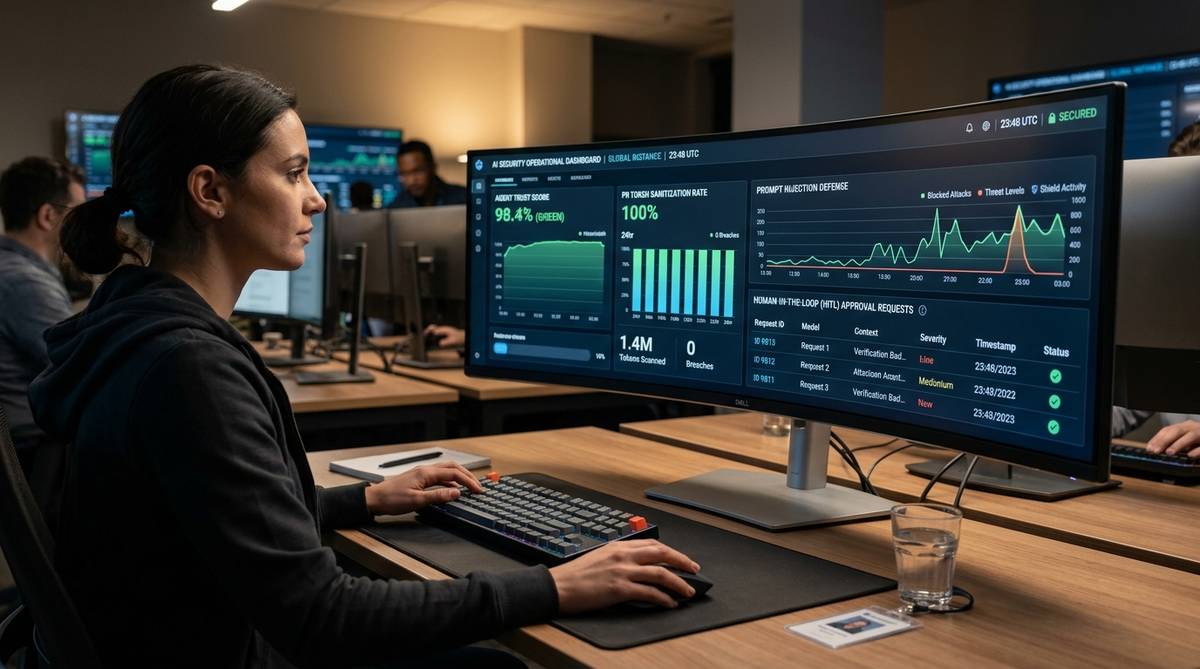
When organizations transition from experimental assistants to production agent fleets, building trust with agentic AI becomes the primary operational bottleneck. Granting autonomous agents access to customer databases, API credentials, and internal communication systems introduces distinct security vulnerabilities that perimeter network controls cannot mitigate alone.
Key security vectors in enterprise agentic deployments include:
Indirect Prompt Injection: When an agent fetches external web content, reads email attachments, or queries customer support tickets, hidden text instructions can override the system prompt, causing the agent to execute unauthorized tool commands.
Voice Biometric and Fraud Verification: In voice-activated and telecommunications workflows, authenticating callers before triggering agentic actions is paramount. Industry solutions like Pindrop provide voice biometric authentication and deepfake audio detection, building trust with agentic AI from pindrop integrations by verifying speaker identity before autonomous assistants initiate financial transfers or credential resets.
Human-in-the-Loop (HITL) Guardrails: Non-destructive actions (such as reading logs or generating draft reports) execute autonomously. In contrast, state-altering operations (such as deleting virtual machines or dropping database tables) require mandatory human approval gates before the hosting runtime dispatches the API payload.
Role-Based Scope Limiting: Each agent in a multi-agent team must operate under the principle of least privilege. A research agent requires outbound web access but zero database credentials; a database agent requires local network connectivity but zero outbound internet access.
To inspect how enterprise cloud environments configure least-privilege identity federation and automated security auditing, evaluate our detailed setup on Microsoft Defender for Cloud setup and auditing.
Troubleshooting Agentic Loops and Failure Modes
Operating autonomous agents in production requires proactive error handling and diagnostic telemetry. When an agent malfunctions, it typically falls into one of three standard failure modes:
Runaway Cyclic Loops: The agent repeatedly calls the same tool with identical invalid parameters. To resolve this, configure cyclic trajectory detection that hashes tool inputs. If an agent repeats an identical signature twice, force the reasoning engine to re-evaluate its strategy or terminate execution.
Schema Validation Errors: The reasoning model returns malformed JSON or omits required fields in the function call. Resolve this by applying Pydantic validation at the runtime boundary; when validation fails, feed the parser error back to the agent as an observation so it can correct the syntax.
Context Window Saturation: Lengthy tool outputs (such as massive JSON payloads or terminal traces) quickly flood the context window, degrading the model's reasoning capabilities. Mitigate this by placing summarizer nodes between tool execution and the reasoning core, filtering out non-essential raw data before updating memory.
Token Economics and Cost Optimization for Agentic Fleets
Because agentic workflows execute multiple reasoning turns and iterative tool evaluations per request, token expenditures can scale rapidly. An automation task that consumes 500 tokens in a single-turn prompt may require 15,000 to 40,000 tokens when orchestrated across a multi-agent team.
To maintain sustainable operational costs, deploy tiered model architectures. Route simple triage, data extraction, and tool formatting to smaller, high-speed models (such as Flash models), reserving large frontier reasoning models exclusively for the central planning and evaluation nodes. Additionally, implement semantic caching for idempotent tool calls to prevent redundant network invocations across repetitive workflows.
Frequently Asked Questions
A standard large language model operates as a stateless text generator producing a single response per prompt. An Agentic AI system possesses agency: it formulates sequential action plans, calls external software tools via APIs, inspects execution errors, and iterates through a feedback loop until a goal is achieved.
Evan Mitchell• Cloud Infrastructure Specialist & Systems Administrator3+ Years Industry Experience
Systems administrator with 3+ years managing enterprise Linux servers, AWS EC2 instances, and Docker containers. Evan focuses on practical bash scripting and secure network configurations.